Once Again Its the Liquidation Crew and We Return for You Like This
Getty Images
En español | COVID-19 did not create the so-chosen retail apocalypse. More than than 9,300 U.S. stores closed in 2019, and over 5,800 did the yr before that, according to tracking by Coresight Research. A timeline past business concern analytics firm CB Insights dates the apocalypse to at least 2015.
But the pandemic has been its most swiftly subversive horseman. Following years that saw major retailers swapping hands in debt-bingeing buyouts while consumers shifted from shopping malls to shopping online, the mass shutdown of 2020 pushed some of America's nearly iconic brands to the brink.
The pandemic brought a parade of headline-making Chapter xi filings, with historic department stores and apparel purveyors at the front. And while defalcation doesn't necessarily mean out of business, the fiscal fallout from COVID-nineteen did kill a few storied bondage, shrink others and usher several into a new, online-only form. Here are some of the biggest-proper noun bankruptcies to date and what their reorganizations wrought.
Ascena Retail (Lane Bryant, Ann Taylor)
Founded: 1962 (as DressBarn)
Filed for bankruptcy: July 23, 2020
Facing some $1 billion in debt, the visitor backside some of the best-known names in women's manner sold all its brands and shed nigh of its approximately two,800 stores as part of a Chapter xi restructuring that won court approval in March.
Ascena'south biggest names — plus-size bellwether Lane Bryant and premium brands Ann Taylor, Loft and Lou & Grey — were sold in December to an affiliate of private equity firm Sycamore Partners, which owns Belk (meet below) and several other well-known bondage. Ii other Ascena brands — tween fashion chain Justice and plus-size line Catherines — were sold earlier in 2020 and airtight all their stores (Catherines continues to operate online).
The original bankruptcy filing came about vii months subsequently Ascena liquidated the last stores in its original line, DressBarn, which at present operates online but under new ownership.
Belk
Founded: 1888
Filed for bankruptcy: February. 23, 2021
The venerable department store that brands itself the home of "Modernistic. Southern. Style." spent only a day in Affiliate 11, emerging from bankruptcy February. 24 with court blessing of a reorganization program that provides $225 million in new capital and eliminates $450 1000000 in debt.
Belk's primary financial officer said in a court declaration that the company faced liquidation without fast action on the restructuring blueprint worked out between its majority owner, Sycamore Partners, and key lenders. The deal kept open all 291 Belk stores in 16 Southern and Southeastern states, with no job losses.
Founded by brothers William Henry and John Belk in Monroe, Northward Carolina, Belk grew into the nation's largest privately owned section store chain and stayed in the family unit until Sycamore'southward 2015 leveraged buyout, which left the visitor heavily indebted. The pandemic farther walloped Belk's finances, prompting restructuring talks to start in late 2020, according to court papers.
Brooks Brothers
Founded: 1818
Filed for bankruptcy: July 8, 2020
The brand that for generations defined the American way of dressing for success — peculiarly the American male executive way — faced strong headwinds as people increasingly dressed downwards for the office and and so, with the pandemic, stopped going entirely. When it entered Chapter xi, the land's oldest ready-to-habiliment clothing retailer had already opted not to reopen 20 percentage of its roughly 250 U.S. stores that went dormant in March, and it's expected to close its 3 U.S. factories.
In a postal service on its Facebook page, Brooks Brothers said bankruptcy proceedings would help it facilitate an ongoing sale process while managing "what has been an incredibly challenging period for all industries, especially retail." A joint venture of mall programmer Simon Belongings Grouping and Accurate Brands Group, a brand-management firm, won court approval Aug. 17 to buy Brooks Brothers for $325 1000000. The new owners pledged to proceed at least 125 Brooks Brothers stores open up.
The joint venture, called the Sparc Group, has too purchased bankrupt jeans retailer Lucky Brand.
CEC Entertainment (Chuck E. Cheese)
Founded: 1977
Filed for bankruptcy: June 25, 2020
The 600-plus restaurant concatenation — whose pizza, arcade games and (until it was retired in 2019) animatronic band fueled endless raucous kids' parties — was specially hard-hitting by a pandemic that halted dining out and large gatherings virtually overnight. The company saw revenue plummet by 90 percent, increasing force per unit area to bargain with nearly $one billion in long-term debt.
CEC, which also owns the similarly themed Peter Piper Pizza concatenation, completed its restructuring at the stop of 2020 with new ownership and about $705 meg less in debt. The company and its franchisees operate 559 Chuck Eastward. Cheese and 122 Peter Piper Pizza locations, most of which accept reopened since the wave of coronavirus closures in the leap of 2020. Nearly four dozen locations shuttered during the pandemic were closed permanently.
Century 21 Stores
Founded: 1961
Filed for bankruptcy: Sept. 10, 2020
The family-endemic department store that pioneered off-toll retail in downtown Manhattan closed all 13 of its mostly New York Urban center–area locations under Chapter eleven proceedings but recently announced comeback plans.
Billing itself equally "New York's All-time Kept Hugger-mugger," Century 21 offered deep discounts on designer wearing apparel and accessories. The original shop, located in the shadow of the Earth Trade Centre, survived the 9/11 terror attacks. But the company was unable to outlive the pandemic, blaming its demise on insurers declining to pay $175 million in claims Century 21 contended it was owed under business organisation-interruption policies.
In February, Century 21 announced it would "officially relaunch" in 2021, starting with its first international store in Busan, Due south Korea. That shop is set to open in early summer, followed by "farther global expansion equally well as the relaunch of the make in New York and beyond the country," the company said.
GNC
Founded: 1935
Filed for bankruptcy: June 23, 2020
Opened 85 years agone as a Pittsburgh wellness food shop that featured the then-exotic specialty of yogurt, what became Full general Nutrition Middle grew into a mall-staple seller of vitamins, supplements, and dazzler and dietary products, with some 4,800 retail locations. The company has closed about ane,300 stores in the U.S. and Canada as part of its Affiliate 11 restructuring.
With the decline of malls, GNC had already closed several hundred stores in contempo years but still accumulated heavy debt. In an FAQ list for customers, the company says efforts to refinance the debt and "position ourselves for long-term growth" were derailed by the pandemic. GNC exited bankruptcy in October afterward completing a $770 million sale to its biggest shareholder, Cathay-based Harbin Pharmaceutical Group.
Guitar Centre
Founded: 1959 (as The Organ Centre)
Filed for defalcation: Nov. 21, 2020
The country's biggest retailer of musical instruments filed for Chapter 11 reorganization eight days afterwards unveiling a restructuring plan supported past creditors and new investors aimed at paring $800 meg from a $one.three billion debt load. The plan won court blessing Dec. 17, assuasive the company to wind up defalcation proceedings a few days later without disrupting operations at its nearly 300 Guitar Center stores and some 225 Music & Arts outlets specializing in ring and orchestral instruments.
Originally a Hollywood store selling organs and pocket-sized appliances, Guitar Centre took on a new name and focus in 1964 as the Beatles' arrival fueled booming need for electrical guitars and amplifiers. Starting in the 1980s, it grew into a national chain that nurtured the aspirations of generations of would-be guitar heroes, just the company struggled in recent years with debt left over from a 2007 acquisition by Bain Capital and growing competition from online sellers.
J.C. Penney
Founded: 1902
Filed for defalcation: May fifteen, 2020
An American establishment that anchors malls coast to declension, J.C. Penney was already in a long-term struggle for survival when COVID-19 hitting, having lost billions during the 2010s and shrinking from more one,000 stores to nigh 850 when it filed for Chapter 11 protection in May.
In the initial months of the pandemic, sales plunged by more than half and the visitor'south long-term debt grew to virtually $5 billion, according to SEC filings. In July, Penney announced plans to close another 150 stores every bit part of a restructuring designed to "create a smaller, more than financially flexible company."
Penney largely exited Chapter eleven with a deal that won courtroom approval in belatedly 2020. Almost of its retail and operating assets were sold to its 2 biggest landlords, mall operators Brookfield Asset Direction and Simon Belongings Grouping, while a consortium of lenders took over about 160 store properties and 6 distribution centers, which Penney will rent back.
J. Crew
Founded: 1947 (every bit Popular Merchandise Inc.)
Filed for bankruptcy: May iv, 2020
The brand that became synonymous with preppy style (don't take our word for it; inquire the Urban Dictionary) has had a tumultuous recent history, churning through CEOs as it battled debt and changing consumer tastes. The company's Chapter 11 restructuring appears set to convalesce at least one of those issues, with lenders agreeing to convert almost all of J. Crew's $ane.7 billion debt into equity. A bankruptcy gauge approved the plan on Aug. 25, and the company exited Affiliate eleven on Sept. x.
In the meantime, about 95 percent of the company'south nearly 500 J. Crew, Madewell and J. Crew Factory stores shuttered at the start of the pandemic accept reopened. J. Crew closed 8 stores permanently in Baronial and had targeted dozens more for termination as part of its "real manor optimization strategy," simply those plans were paused when the company secured new terms with landlords that are projected to save it $130 1000000 on its leases this year and next.
Lord & Taylor
Founded: 1826
Filed for bankruptcy: Aug. 2, 2020
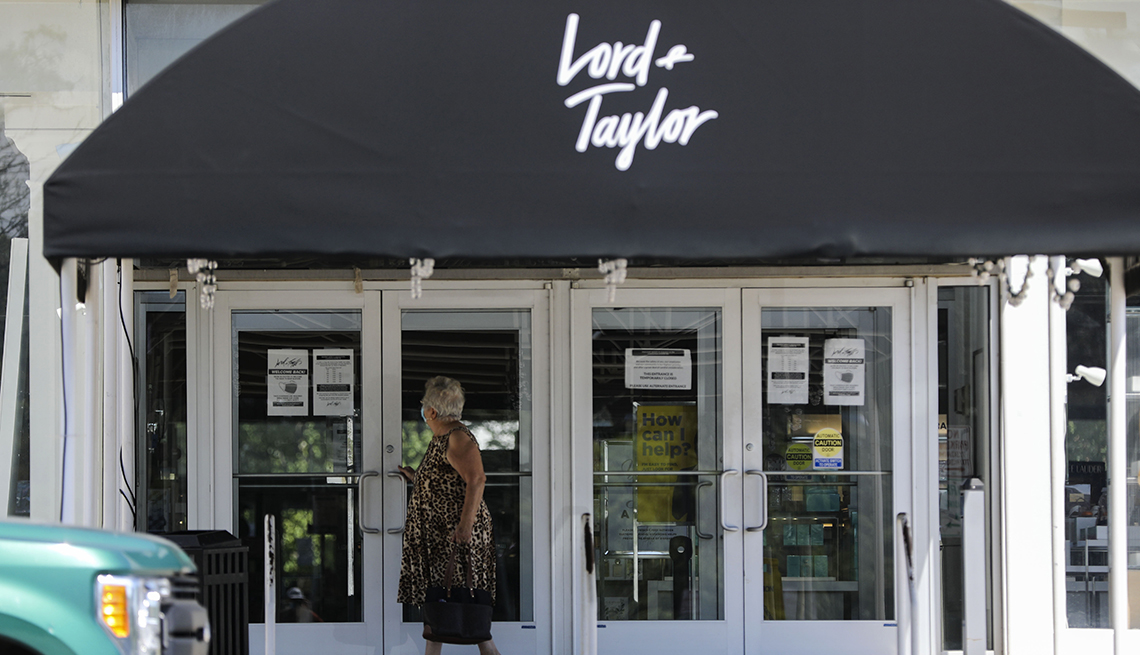
The nation's oldest department store appear Aug. 27 that it would close all 38 of its locations. The death discover came near a year to the twenty-four hour period after Lord & Taylor was caused by manner-rental startup Le Tote, and 25 days after both companies filed for Chapter 11 protection.
Lord & Taylor pinned the bankruptcy filing on the "unprecedented strain" on its business from COVID-19. But the iconic retailer had been struggling since well before the pandemic, shifting through multiple owners in recent years (including, at different times, the corporate parents of former rivals Macy's and Saks 5th Avenue) and endmost its historic flagship store on 5th Avenue in New York City, which became a WeWork in 2019.
The last concrete Lord & Taylor stores shut their doors in tardily February, simply in April the brand relaunched as a digital "collective store" under a new owner, investment and retail business firm the Saadia Group.
Neiman Marcus
Founded: 1907
Filed for bankruptcy: May 7, 2020
The loftier-stop section store, which also owns the even more high-cease Bergdorf Goodman, entered Chapter eleven with a debt load of $5.1 billion, a hangover from two leveraged buyouts since 2005 and changing consumer habits. Neiman Marcus said in its bankruptcy filing that the pandemic disruption forced it to "proactively address its liquidity position and capital structure."
The company exited defalcation in September, afterward winning court approval for a reorganization plan that will eliminate more than $4 billion in debt, and emerged from Affiliate 11 in late September under new owners, including investment firms PIMCO, Sixth Street and Davidson Kempner Capital Management. It has closed a handful of Neiman Marcus stores along with almost all of its Terminal Call clearance centers.
Pier 1
Founded: 1962
Filed for bankruptcy: Feb. 17, 2020
Long the country's go-to purveyor of funky home goods, Pier one isn't technically a pandemic defalcation: Its Chapter eleven filing came a few weeks before the shutdowns and stay-at-abode orders. But the coronavirus finished what years of shrinking sales and spiraling losses started. Later initially announcing plans to shutter up to 450 of its 900-plus stores while searching for a buyer, the company said in May that it would liquidate the entire chain.
Pier 1 spent months trying to notice a buyer that would maintain the chain but constitute no takers in a pandemic-ravaged retail environs. Instead, the company'south intellectual assets were scooped up at a defalcation auction by Retail Ecommerce Ventures (REV), a start-up visitor that relaunches distressed or defunct store brands every bit online retailers.
Stein Mart
Founded: 1908
Filed for defalcation: Aug. 12, 2020
The discount department store, which grew from early on-20th-century roots in the Mississippi Delta into a national name in off-toll fashion, commenced going-out-of-business organisation sales at all its approximately 280 stores afterward filing for Chapter 11 defalcation.
Stein Mart began, and operated for decades, every bit a single family-run shop in Greenville, Mississippi. The company started expanding rapidly later moving its offices to Florida in the 1980s and going public in 1992, condign a shopping-heart staple in the Southeast and eventually reaching 30 states.
But Stein Mart had not turned a profit since 2015, and sales plunged by more than than half in the get-go quarter of 2020 while debt grew to about $200 million. The Stein Mart name was purchased in Dec by REV, which rebooted the make as an online-simply shop, as information technology has done for other bankruptcy victims like Pier 1 and Modell'south Sporting Goods.
Tailored Brands (Men's Wearhouse, Jos. A. Bank)
Founded: 1973 (as Men's Wearhouse)
Filed for bankruptcy: Aug. 2, 2020
The menswear conglomerate sought Chapter 11 protection two weeks later announcing plans to reduce its corporate workforce by 20 percent and to close upward to 500 of its 1,450 stores. Information technology emerged from bankruptcy Dec. 1, subsequently winning court blessing the previous month for a restructuring that eliminated $686 million in debt.
Tailored Brands is the successor company to Men's Wearhouse, a dominant player in the men's suit market long known for its TV commercials featuring founder George Zimmer promising, "You're going to like the way you look." It acquired rival Jos. A. Bank in 2014 after a contentious takeover boxing and too owns 1000&M Manner Superstore and Canadian menswear chain Moores. The company was already being buffeted by longtime consumer shifts to east-commerce and more casual office wearable when the pandemic hitting.
10 more than large-proper noun bankruptcies
These well-known names are also among more than than 100 companies that take filed for Chapter xi protection during the pandemic.
Dean & Deluca
Business: Gourmet grocery
Filing: Apr two, 2020
Status: Reorganization approved in November, exited bankruptcy in February
Gold's Gym
Business: Fitness
Filing: May 4, 2020
Status: Sold to European fitness company RSG Group at court-approved auction in July
Hertz
Business organization: Auto rental
Filing: May 22, 2020
Status: Aiming to exit Chapter eleven in June, following proposed $four.2 billion sale
Le Pain Quotidien
Business: Bakery café
Filing: May 27, 2020
Status: Sold to franchising grouping Aurify Brands, which has reopened some locations and announced expansion plans
Lucky Brand
Business: Denim
Filing: July three, 2020
Status: Sold in Baronial to a joint venture of mall operator Simon Holding Group and licensing firm Authentic Brands Grouping
Modell's Sporting Goods
Business: Athletic apparel and gear
Filing: March 11, 2020
Condition: Closed all stores; sold and relaunched as online retailer
Muji
Business: Home goods
Filing: July 10, 2020
Status: The Japanese maker of minimalist decor has closed viii of its 18 U.Southward. stores.
RTW Retailwinds (New York & Visitor)
Business: Fashion
Filing: July 13, 2020
Status: Closed all stores; sold and relaunched as online retailer
Phase Stores (Gordmans)
Business: Department store
Filing: May 10, 2020
Status: Out of concern
Tuesday Morning time
Business concern: Off-cost department store
Filing: May 27, 2020
Condition: Completed reorganization and exited defalcation in Jan
hunterbefouself78.blogspot.com
Source: https://www.aarp.org/money/credit-loans-debt/info-2020/bankrupt-retail-chain-store-list-is-growing.html
0 Response to "Once Again Its the Liquidation Crew and We Return for You Like This"
Postar um comentário